



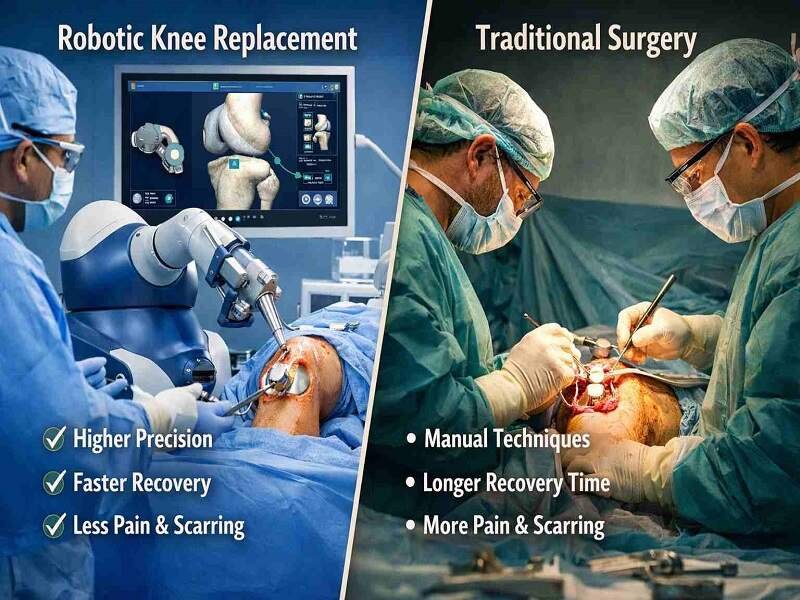
Knee pain may make even the most basic things, such as climbing the stairs or running after your grandchildren, a daily challenge. The question that most frequently comes to the mind of many patients who research knee replacement surgery in Rohini is: Is it better to use robotic technology or have a traditional approach? It is a legitimate worry. After all, when a surgeon is speaking of robots, they envision things ranging from sci-fi accuracy to a machine replacing the operating room. Calm down–the robot does not substitute the surgeon. It only makes the surgeon more precise.
We will dissect the distinction between robotic knee replacement and conventional surgery using objective facts, professional experience, and reliable medical literature in this guide. We want to do one thing, to make you make a steady and knowledgeable decision.
Understanding Knee Replacement Surgery
Knee replacement is a procedure that entails the removal of damaged cartilage and bone of the knee joint and substitution with artificial parts. It is prescribed by the doctors when the patient has chronic pain and restricted mobility due to severe arthritis, injury, or wear and tear.
The American Academy of Orthopaedic Surgeons (AAOS) indicates that over 90 percent of contemporary knee replacements work out effectively in 15-20 years when done properly. This statistic in itself demonstrates the extent of reliability of this procedure.
Experience, technology, and patient outcomes are the key factors that patients seeking the best hospital in Rohini tend to look at. These aspects are much more important than advertising statements or glitzy brochures.
What Is Robotic Knee Replacement?
Robotic knee replacement involves the use of high-technology computer-guided technology to support the surgeon throughout the operation. The system generates a 3D simulation of your knee prior to surgery. This model aids the surgeon to plan the actual location and orientation of the implant.
In robotic knee replacement surgery, the robot arm directs the movements of the surgeon with the highest precision. Imagine it as GPS navigation, it does not drive the car, but it does not allow going the wrong way.
Key Features of Robotic Surgery
- Very precise positioning of implants.
- Customized surgical planning
- Less tissue damage in the surrounding region.
- Better joint alignment
A study published in the Journal of Arthroplasty indicates that robots have the ability to enhance the accuracy of implant positioning when compared to manual procedures. Long-term joint performance is significantly contributed by proper alignment.
Also Read : What Not to Do After Knee Replacement Surgery
What Happens in Traditional Surgery?
The traditional surgery is fully dependent on the ability of the surgeon and the manual tools. Mechanical guides are used by the surgeons to position the implant. This technique has been effective over several decades and continues to give great outcomes when carried out by skilled professionals.
Most of the hospitals which are top-ranked among the top hospital in Rohini still provide traditional procedures since they are safe, efficient, and affordable.
Advantages of Standard Surgery.
- Consistent and commonplace.
- Shorter setup time
- Lower equipment cost
- Existence of strong long term success record.
The reality is plain and straightforward: conventional approaches have not become obsolete. Modern orthopedic care is based on them.
Robotic vs Traditional Surgery: The Real Differences
We will compare the two approaches on a practical basis.
1. Accuracy and Precision
Robotics also enables physicians to insert implants with precision of a millimeter. National Institute of Health and Care Excellence (NICE) studies show that there is a higher consistency of alignments with robotic-assisted procedures.
Greater correspondence tends to produce:
- Smoother movement
- Reduced wear of the implant.
- Improved long-term stability
Nonetheless, even a skilled surgeon who practices classic surgical approaches would be able to attain high alignment. Technology is not all that is needed.
2. Recovery Time
Numerous patients who have robotic surgery for knee replacement complain of reduced postoperative pain and earlier recovery. The robotic system directs movements precisely, thus safeguarding neighboring tissue better than surgeons can.
Nevertheless, the speed of recovery is determined by:
- Patient health
- Rehabilitation effort
- Surgical expertise
Simply put, technology will assist, but discipline in the course of physiotherapy will assist even further.
3. Surgical Safety
In both processes, safety is the first consideration. Regardless of the technique, hospitals have rigorous sterilization and monitoring measures.
According to the British Orthopaedic Association, there are no significant differences in complication rates with robotic and traditional surgery when done in accredited centers. This observation will ease the minds of patients who fear that new technology will be risky.
When you are planning knee replacement surgery in Rohini, never forget to inquire whether the hospital is well accredited and with skilled orthopedic teams.
4. Cost Considerations
Robotic systems entail sophisticated equipment and computer programs. Naturally, this technology increases the procedure cost.
The most common causes of increased pricing are:
- Specialized machinery
- Preoperative imaging
- Robotic system maintenance.
It does not imply that robotic procedures are excessively expensive. Airmid Hospital is just a reflection of innovation costs.
Value should be compared and not price only by the patients seeking the best hospital in Delhi. Some complications can be minimized by making a slightly increased investment.
Who Should Choose Robotic Knee Replacement?
Robotic knee replacement can be a powerful solution to the patients who:
- Possess complex knee deformities.
- Require a very accurate positioning of the implants.
- Desire tailor surgical planning.
- Demand high-tech care.
Robotic systems are also likely to be accurate, which is why middle-aged adults and active seniors are likely to value this feature as it helps maintain proper joint performance in the long term.
In case you are interested in advanced orthopedic services, visit the position of Airmid Hospital on its Google My Business profile. This is the standard technique that many patients doing research on the trusted hospital in Rohini use to ascertain that there is accessibility, reviews and facilities before they can book a consultation.
Who Should Consider Traditional Surgery?
Conventional surgery is the best thing to do to a patient, particularly when:
- The knee disorder is simple.
- One of the main concerns is budget.
- The surgeon is a well experienced manualist.
- It does not require robotic systems.
It is important to keep in mind that sometimes the skill of the surgeon is more valuable than the applied technology. With either technique, a qualified orthopedic surgeon is capable of producing great results.
How to Choose the Right Hospital and Surgeon
The choice of the appropriate medical team will be the most significant choice you will make.
The following are some of the steps to be taken:
Check Surgeon Experience
Inquire of the surgeon the number of knee replacements he does annually. Increased volume is normally associated with increased expertise.
Inspect Technology and Facilities.
The hospitals that provide the robotic and manual services exhibit versatility in their services to patients.
Read patient verified feedback.
Online reviews and testimonials give good feedback of first hand experiences.
The keywords to look into when studying knee replacement surgery in Delhi include transparency, safety measures, and patient satisfaction in the long-term perspective of patients, as opposed to glamorous adverts.
The Bottom Line: Which Option Delivers Better Results?
Robotic knee replacement and traditional knee operation both are good procedures, provided Airmid Hospital is carried out by experienced surgeons. The distinction is in accuracy, personalization, and price, rather than safety.
Here is the honest summary:
- Robotic surgery is more accurate and customized.
- Old fashioned surgery is still stable and economical.
- Experience in surgeons contributes the most to success.
- Long-term mobility is determined by rehabilitation.
Imagine it in the following way: there is no difference in robotic and traditional surgery since it is similar to automatic and manual driving. We both arrive at the place without accidents- the driver still takes charge of the trip.
Trusted Medical Sources
- American Academy of Orthopaedic Surgeons (AAOS).
- National Institute For Health and Care Excellence (NICE).
- Journal of Arthroplasty
- British Orthopaedic Association
- National Institutes of Health (NIH).
These are organizations that publish peer-reviewed research and clinical guidelines that are commonly used by orthopedic specialists globally.
Final Thoughts
Millions of lives have been changed through knee replacement. Modern technology still enhances accuracy and survival but the basics are unchanged: qualified surgeons, adequate planning and regular rehabilitation.
In case your daily routine is hindered by knee pain, do not delay until the issue gets worse. Consultation early in life can assist doctors in making the most appropriate choice of treatment and reestablishes your mobility in the shortest possible time.