



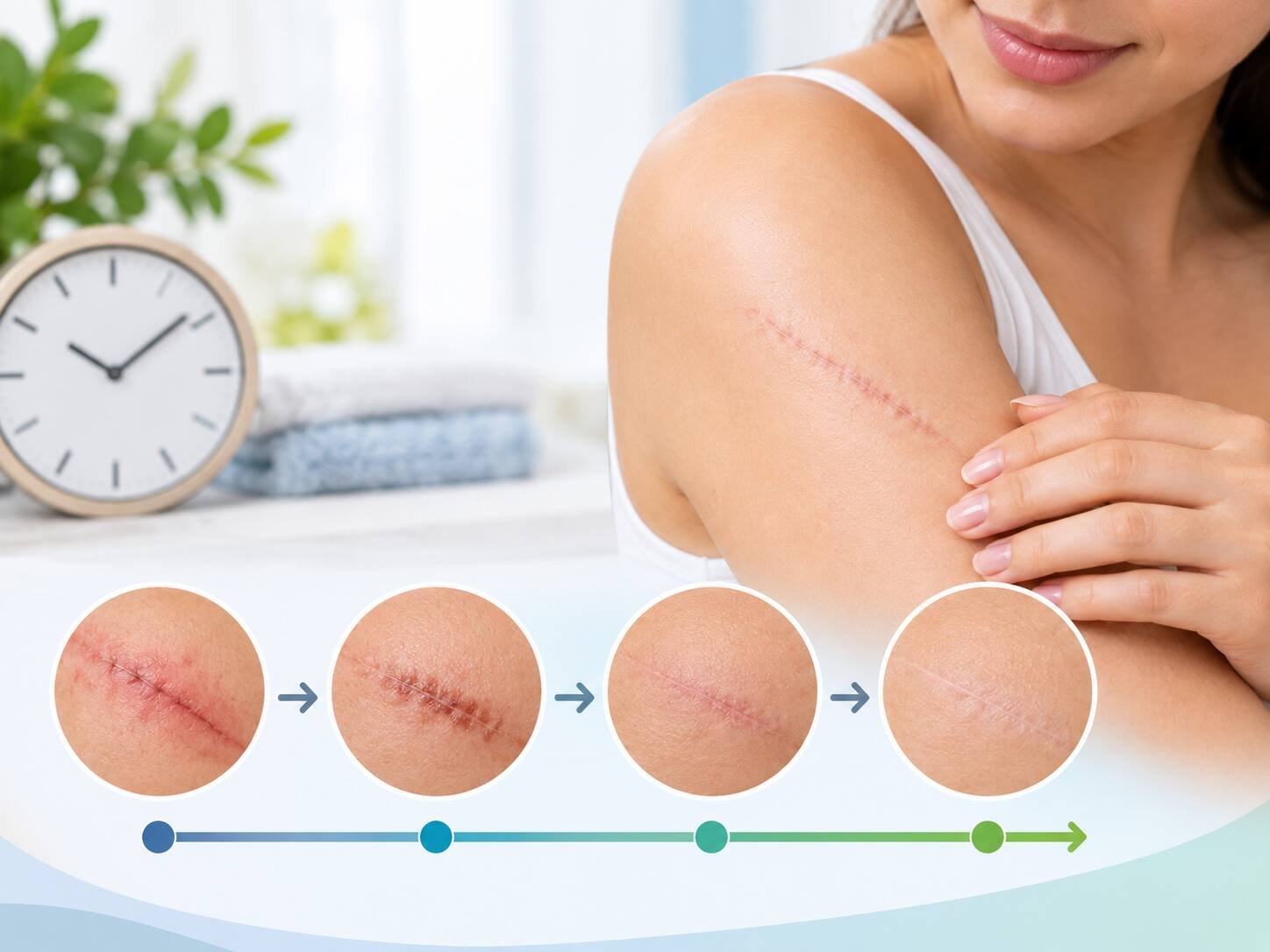
Have you ever seen a new scar and asked yourself how long does it take for a scar to heal and why it seems to be red and thick despite the fact that the wound is already healed? There is no universal answer to this question. In Airmid Hospital in Delhi, Rohini, Rithala and Samaypur Badli, you will have your scar evaluated in accordance with the wound, its location and its specific healing process. If you are searching for the best hospital in Rohini, it is worth knowing that scar healing time can extend well beyond the point when the skin first closes. A scar can continue changing in colour, texture and thickness for many months.
How Long Is the Scar Healing Time?
It is possible that a wound heals quite fast; however, it doesn’t necessarily mean that the scar has healed too. After the skin wound closes, the body will continue to repair itself as well as reorganise its collagen. This process is referred to as scar maturation.
Therefore, how many months do you think it would take for the scar to heal? The most part of scars will keep on changing for several months, and some other scars may require up to 12 to 18 months or even two years.
In this case, it is possible for a scar to soften, flatten, and fade. In addition, there can be early redness, slight swelling, hardness or itching.
Understanding the Scar Healing Process
The scar healing process happens gradually. After wound closure, the body produces collagen to repair the deeper layers of damaged skin. Over time, this collagen is reorganised, helping the scar become less firm and noticeable.
The main scar healing stages can be understood simply:
- Early repair, when the wound closes and new tissue develops.
- Remodelling, when collagen is reorganised and the scar slowly changes in colour, thickness and texture.
This is why a fresh scar may look very different from the same scar several months later. Scar tissue healing is a gradual process, not something that finishes within a few days.
Why Do Scars Appear Red or Dark-Colored?
Scar discoloration is a concern for many people. Scars can appear pink or red and may darken as they mature. Eventually, scars may appear to be the same color as the skin that surrounds them.
The appearance of a scar can be affected by the level of a skin injury, the location of the injury, the care of the injured skin, and the skin type.
It is a common question how long does it take for a scar to become less visible. The answer is scars can take a long time to fade and become less visible. Unfortunately, scars do not always disappear.
What Can Change Your Healing Timeline?
There is no fixed scar healing time for every person. A small superficial cut may settle differently from a deeper wound or a surgical incision.
Your healing may also be influenced by:
- The size and depth of the wound
- The location of the scar and how much the area moves
- Infection or delayed wound healing
- Your individual skin and healing response
- The type of injury or surgery
This is one reason surgical scar healing time can vary considerably. A scar near a joint, for example, may experience more movement than one in an area with less tension.
A raised scar, keloid or depressed scar may also follow a different pattern from a flat scar.
Can You Help a Scar Heal Properly?
Good wound care is important from the beginning. Once the wound has completely healed, your doctor may recommend suitable scar-care measures depending on the type and location of the scar.
Sun protection can help reduce unwanted darkening, while silicone-based products may be useful for some raised scars. Scar massage may also be recommended after the wound has healed, but it should not be started over an open wound.
At Airmid Hospital, patients looking for a plastic surgery specialist in Rohini can discuss changes in their scar and understand whether simple scar care or further treatment may be appropriate.
When Should You Get a Scar Checked?
A scar does not always need treatment. However, it is worth getting professional advice if it becomes increasingly raised, painful, itchy, unusually thick or tight. A scar that restricts movement also deserves attention.
For people looking for scar treatment in Delhi, scar treatment in Rohini, scar treatment in Rithala, a scar specialist in Delhi, scar treatment near Samaypur Badli or a scar consultation in Rohini, an examination can help identify the type of scar and whether it is still naturally maturing.
A keloid, for example, can grow beyond the original wound, while a hypertrophic scar usually remains within the boundaries of the original injury. Different scars may require different approaches.
Read This Also
Scar Revision Surgery: When Can a Scar Be Improved?
Conclusion
Understanding scar healing time can help you avoid judging a scar too early. A scar that looks prominent during the first few months may continue to soften and fade as it matures. Airmid Hospital can help assess scars that remain concerning and explain suitable options based on their type and stage of healing.
Visit the Google My Business profile of Airmid Hospital to learn more. You can also Contact Us for a scar consultation and discuss your concerns with the appropriate medical professional.
Frequently Asked Questions
How long does a scar take to heal?
The wound may close within weeks, but scar healing time is much longer. A scar can continue changing for 12 to 18 months or more, depending on the individual and the wound.
What are the stages of scar healing?
The main stages involve wound repair followed by collagen remodelling. During this period, the scar can gradually become softer, flatter and less noticeable.
Why is my scar still red after months?
Redness can remain while the scar is maturing. New scars commonly appear pink or red before gradually changing colour.
Can a scar take a year to heal?
Yes. Scar healing time can extend to a year or longer. Some scars continue maturing for up to 18 months or two years.
When should I see a doctor about a scar?
Seek professional advice if the scar becomes painful, increasingly raised, warm, swollen, infected, very itchy or starts restricting movement.