



Deciding on having plastic surgery generally is not something that occurs on the same day. There are many questions that need answering and people spend time reading information on the procedure and their results and trying to understand which one would be best for them.
There is a time when reading alone does not suffice anymore. You have to discuss your issue with someone and get an answer according to your personal case.
Here is the moment of plastic surgery consultation.
This is your opportunity to tell what you are worried about and what your possibilities are.
What happens when you meet the surgeon?
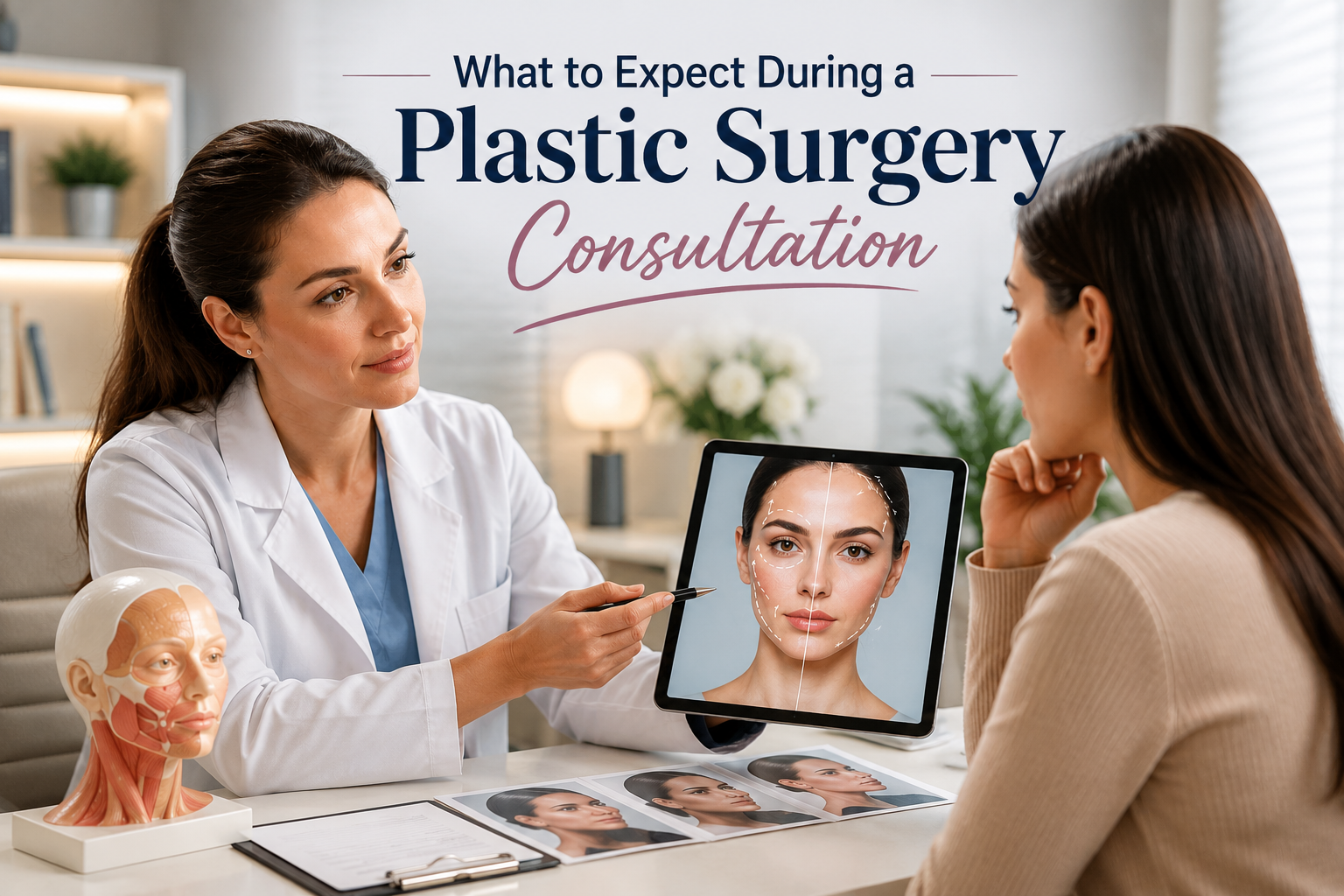
The appointment will usually begin with a conversation.
You may or may not be familiar with the name of the procedure you’re interested in. It’s perfectly okay either way.
Let the surgeon know what it is that you don’t like or what you want to change. It’s best to explain what your desired outcome would be using your own terms, not necessarily the clinical terms.
The surgeon will also ask about your health and medical history. This can include previous operations, medicines you’re taking, allergies and any other relevant health issues.
It’s important to be honest here. Something that doesn’t seem important to you could still affect whether a particular treatment is suitable.
Will you be examined?
That depends on what you’ve come in to discuss, but in many cases, there will be a physical examination.
The surgeon may assess the skin, tissue, shape or other features of the area you’re concerned about. This gives them a better idea of what can realistically be achieved.
It’s also the point where expectations can be discussed.
Maybe you’ve seen a photograph online and have a particular result in mind. You can certainly show it to the surgeon. Just don’t assume that your result will be identical.
Every person’s body is different, and surgery has to be planned accordingly.
What should you ask?
A plastic surgery consultation is an opportunity for you to learn, so ask all your questions.
You may want to ask:
- Do you feel that this operation is right for me?
- Can there be any other alternatives that I might explore?
- What happens during the operation?
- How long is recovery likely to take?
- Will I have scars?
- What are the potential complications?
- When may I return to work?
- What kind of outcome am I likely to get?
There isn’t a “right” number of questions to ask.
Be honest about any confusion you may have. Making a medical choice is a little bit easier when you know what it entails.
Talk honestly about what you want
People sometimes find this part difficult.
You might feel awkward when trying to express what you do not like about certain body parts. Yet there is absolutely no need for embarrassment – it is precisely the discussion that will take place between you and the surgeon.
It is very necessary to say in advance what results should be obtained from the procedure.
However, one should also remember that one may change one’s mind about the chosen option following the conversation with the surgeon.
Patients have an opportunity to discuss all these aspects with doctors at Airmid Hospital.
You don’t have to decide that day
One of the most important things to know about a consultation is that you aren’t signing up for surgery simply by attending an appointment.
You might decide that you want to move ahead. You might decide that you need more time. Or you might find that surgery isn’t the right option for you.
These are all possible results.
It is fine if you walk out of the consultation with even more questions. You could ask them at a later date or seek a second opinion altogether.
How do you choose the right surgeon?
If you’re searching for a plastic surgery specialist in Rithala, look beyond the price of the procedure.
Check the surgeon’s qualifications and experience. If you already have a particular procedure in mind, look for relevant experience rather than assuming every surgeon performs every procedure in exactly the same way.
The consultation itself can also tell you quite a lot.
Pay attention to how the surgeon talks to you. Do they listen? Do they explain things clearly? Do they discuss possible risks as well as the expected benefits?
You should feel comfortable raising concerns.
Should you ask about the cost?
Yes.
There’s nothing wrong with wanting to know how much treatment may cost. However, don’t compare prices without finding out what’s included.
The final cost can depend on the procedure, how complicated it is and other aspects of your treatment and care.
Ask the clinic or hospital to explain the costs clearly so you know what you’re comparing.
What should you bring to your appointment?
You don’t need to prepare anything complicated.
If you have previous medical reports, scans or information about earlier surgery, take them with you if they’re relevant. A current list of medicines can also be useful.
And write down your questions.
It sounds simple, but it’s easy to forget what you wanted to ask once the conversation starts.
Read also
Plastic Surgery vs Cosmetic Surgery: What’s the Difference and Which One Is Right for You?
If you’re still unsure about the difference between plastic and cosmetic surgery, our guide explains the distinction in simple terms.
Final Thoughts
A plastic surgery consultation can give you the time needed to gather the right information prior to making the decision.
There is no need to know everything at the point of arrival at the clinic. Share the problem you are experiencing, pose the right questions, and be truthful about your expectations of the procedure.
Be patient after that. Surgery is a private issue, and the decision must come easily.
Airmid Hospital encourages patients to understand their treatment options before deciding what to do. You can also find Airmid Hospital through our Google Business Profile for more local information.
If you’d like to discuss your concerns or understand your options, Contact Us through the official website.
Frequently Asked Questions
What is typically discussed in a plastic surgery consultation?
In a plastic surgery consultation, your issues, your medical history, your expectations and the various treatment options can be discussed in the process. A physical examination will be done depending on necessity.
Do I have to know the exact procedure I want?
No. You can state what changes you would like to make or your problem.
Can I discuss possible risks and recovery with the doctor?
Yes. This information will help you make the decision to go ahead or not.
Am I required to get the surgery done immediately?
No. You can take time to make up your mind regarding the information gathered.